The video that can take your startup to the next level
You have three minutes. Sometimes less.
That is the actual time an evaluator, a jury, or an investment fund dedicates to understanding your startup before deciding if it deserves a second conversation. In that brief window, you compete with dozens of other proposals that also feature a good idea, a capable team, and promising metrics.
The question is not whether you have something valuable. The question is whether you can communicate it in a way that someone who doesn't know you understands it immediately, remembers it, and wants to learn more.
That is where a well-crafted pitch video goes from being a "nice to have" to a real competitive advantage.
Why the pitch video matters more than you think
Modern evaluation processes—accelerators, funds, innovation contests, corporate programs—increasingly require a video as part of the application. And it makes sense: a video reveals in minutes what a 20-page PDF fails to convey in an hour.
A good pitch video achieves several things at once:
- It shows the problem in a way that makes the evaluator feel it, not just understand it.
- It demonstrates the solution without requiring the viewer to strain their imagination.
- It presents the team with a presence and conviction that no resume can replicate.
- It establishes traction in a visual and memorable way.
But there is something even more critical: the video is the first signal of execution the evaluator receives from your startup. If the video is clunky, poorly edited, or generic, the implicit message is that your team doesn't know how to communicate. And a team that cannot communicate will struggle to sell, recruit, and scale.
What differentiates a pitch video that works from one that doesn't
It's not about an expensive production. It's about clarity and structure.
The first mistake: starting with the solution
Most founders are in love with their product. It's natural. But the evaluator isn't—yet. If you start explaining your platform's features before the viewer has felt the pain point it solves, you lose them.
An effective pitch video always starts with the problem. Not with a cold statistic, but with a concrete, recognizable situation that makes the evaluator think, "Yes, that happens, that hurts." Only then does your solution have context and weight.
The second mistake: trying to say it all
A pitch video is not a demo day or a boardroom presentation. It's a hook. Its only job is to generate enough interest so the viewer wants to know more and schedules a meeting.
That means deliberately leaving things out. A two-minute video with a crystal-clear message always beats a five-minute video attempting to cover every angle of the business.
The third mistake: generic stock animation
If you've seen enough pitch videos, you recognize them immediately: flat icons floating over white backgrounds, library motivational music, a neutral voiceover. They convey the exact same feeling as a blue-template PowerPoint: that the team didn't invest in standing out.
Custom animation—featuring your brand's visual identity, elements representing your specific industry, and a memorable style—communicates seriousness and ambition. It says this is not an experiment; it's a real business.
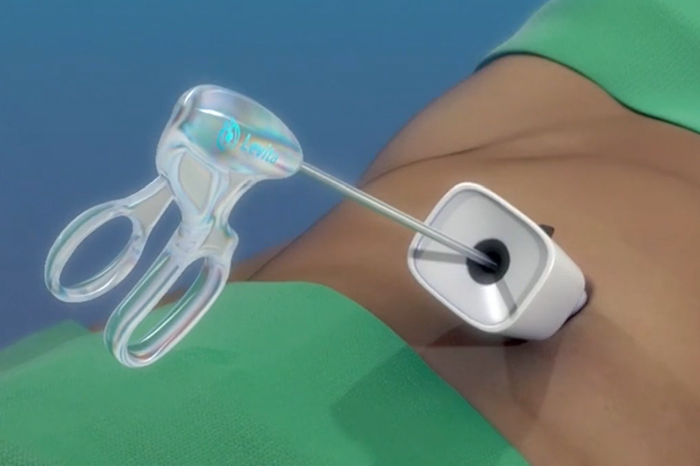
A concrete example: When Levita Magnetics was still an early-stage medical startup, they needed to explain something no one had ever seen before: a magnetic surgery system where an external magnet, placed on the patient's skin, controls a retractor inside the abdomen without an additional incision. The technology was so novel that the FDA had to create an entirely new regulatory category to classify it.
Shooting real clinical footage for a pitch was unfeasible—difficult for non-doctors to interpret and practically impossible to obtain at such an early stage. A 3D animation of the device and its mechanism visualized what otherwise had to be imagined. Any evaluator could understand it in seconds, without being a surgeon.
Today, Levita Magnetics is an FDA-approved company operating in top-tier clinics like Cleveland Clinic and Stanford, with funding rounds including a $26 million Series C. The animation didn't pave that road alone. But in the earliest stages, when there is no clinical history or facilities to show, visual clarity can be the difference between an evaluator who gets it and one who moves on to the next application.
The structure that works at any stage
Whether you are applying to your first accelerator or closing a Series A round, the narrative structure of an effective pitch video remains consistent:
- The problem (20–25% of the video): A specific situation. A character facing an issue. Data to size the magnitude, but only what's necessary.
- The solution (25–30%): What your product does. How it specifically solves the previous problem. If you have a visual demo, this is where it goes.
- Why now and why you (20%): What makes this the exact right time for this solution. What your team has that no one else does: experience, proprietary technology, market access.
- Traction and vision (15–20%): Numbers, if you have them. Customers, pilots, growth. And a glimpse of where this goes if the bet pays off.
- The call to action (5–10%): Clear and direct. What do you want the person who just watched the video to do next?
What kind of video your startup needs according to its stage
Not all startups need the same format. The stage matters.
- Pre-seed: At this stage, you don't have a finished product or robust metrics. Your main asset is the clarity of the problem and the credibility of the team. A Problem + Vision + Team video, featuring animation that illustrates the pain point and the opportunity, is far more honest and effective than faking traction that doesn't exist.
- Seed: You already have something working. The video can showcase the product in action—whether through animated screencasts, real demos, or 3D reconstructions—and combine that with early adoption indicators. The emphasis shifts from "we think this happens" to "we know this happens, and here is the proof."
- Series A and beyond: The video no longer needs to convince anyone that the problem exists or the solution works. It needs to convey scale. The focus is on the long-term vision, the market opportunity, and why this specific team can capture it. Production value must also step up: funds at this stage are used to seeing high-end materials.
What V-Sense brings to this process
We have produced animation and video for industries where communicating complexity clearly is not optional: medicine, mining, technical education, industrial tech. That experience is directly transferable to the startup ecosystem.
What we do is not taking your PowerPoint deck and animating it. We work from the strategic brief: understanding what the evaluator needs to feel, what they must remember, and what action they should take. Then, we build the video that achieves that.
We work with 2D and 3D animation, motion graphics, live-action, or a mix of them all depending on what serves the objective best. But there is one capability that is currently changing the equation for startups: AI visual production.
AI visual production: real situations without the production cost
One of the classic barriers to a quality pitch video is the need to show real-world situations: the problem happening in context, the product being used, real people in recognizable settings. Producing that with cameras, locations, and actors has a cost that many early-stage startups cannot justify.
AI visual production changes that. By leveraging different models depending on what needs to be communicated—image generation, video synthesis, smart compositing—we can illustrate real situations with a level of detail and realism that previously required much larger production budgets.
Does your startup solve a problem in retail, logistics, healthcare, or agriculture? We can showcase that context visually and credibly without setting up a film shoot. The result is a video that feels concrete and grounded in the real world, rather than abstract or generic.
And because we select the right model for the specific objective—instead of using a single tool for everything—the output remains consistent with your brand identity and matches the high-quality standards evaluators expect to see.
In Summary
A pitch video is not just an audiovisual production. It is a sales tool.
And like any sales tool, its value is measured by a single metric: did it generate the conversation you needed?
If you are preparing an application or a funding round and want to discuss how to better communicate your value proposition, let us know what you're building.
Reach out to us below ↓